CANDLES IN THE WINDOW – THE HISTORY BEHIND

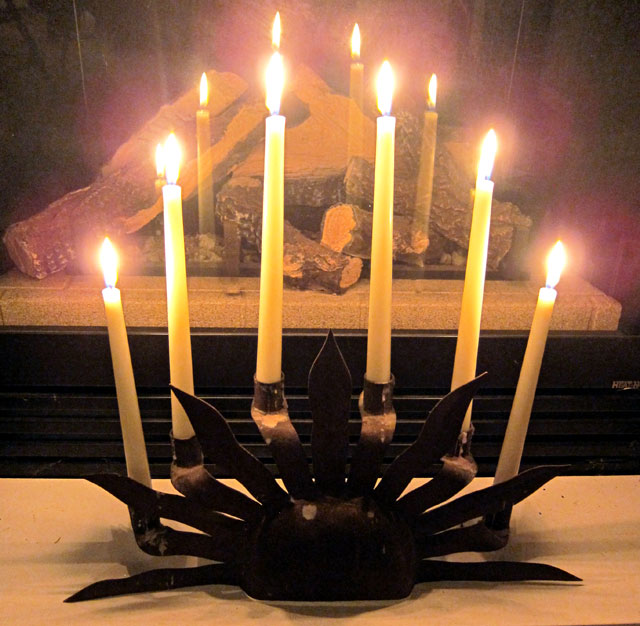
I share a tidbit of history each month in THE WALPOLE CLARION in my “column,” DID YOU KNOW THAT…?  In the December, 2019, issue I explored the background behind placing candles in windows. As the season approaches, you may want to know why candles are appearing, and you may wish to display your own. (28 November 2020 – I write to share, and this post continues to get a high number of daily reads. I would love to know the source directing readers here. Keep looking, thank you, RAY) — 11 December 2021 – this post has become the top Google answer to the question “candles in windows history.” Over 10,000 reads in two years, and over 1,000 in the past two weeks. Update: 29 November 2023 – now, in four years, 31,955 – thank you, a pleasure to share. Thank you so much – RAY (PS – below are the “candles in the windows” of my 1806 Colonial on a quintessential New England Village Common.

DID YOU KNOW THAT…

… the tradition of lighting candles in the windows of homes during Christmas, dating to colonial times, was brought to America by the Irish? Candles in windows have always been considered a sign of welcome to others. In early America, when homes were often miles apart, the sight of a distant candle in a window was a sign of “welcome” to those wishing to visit.

Religious practices and persecution have a long and complicated history in Ireland. As early as 1171, King Henry II’s invasion of Ireland began persecution against the Irish. Pagan solstice celebrations were replaced by Christmas celebrations. Protestantism attempted to replace Catholicism. The British Government, between 1691 and 1778, perfected their oppressive Penal Laws, targeting Catholics in an attempt to squash the religion. Catholic priests were not allowed to practice their faith. Ordered to leave the country, the priests instead went into hiding. The Irish were forced to obey British Rule.

During Christmastime, faithful Irish Catholics would, in darkness, light a candle in the window and leave the door unlocked. This was a sign to priests it was safe to slip into their home to say Mass. In return they offered hospitality to the priest. The British, questioning the Irish about the candles, were told it was their way to welcome Joseph, Mary, and the Baby Jesus as they sought shelter. On immigrating to the United States, the Irish brought this holiday practice with them.

The tradition of the lit candle in the window in colonial America has been interpreted in many ways. It has been seen as a beacon of hope for any passerby during the holiday season, and signaled strangers that there would be food and shelter there, should they ask.  Candles also showed hope that Mary and other saints would pass by their home and bless it. The candle’s welcome was part silent prayer for the safe return of an absent person, and part sign there is someone waiting and tending the fire. Other interpretations say the candle would be sending a message – a child had been born or a family had received a blessing of some nature. Often the candles would be commemorating a community event or celebration. Inns (and now bed and breakfasts) used candles announcing rooms were available, and leading travelers to the door. The key being the sense of welcome.

When Colonial Williamsburg was established, they were unsure how Christmas should be represented. Remember, it was not much of a holiday in colonial America. They hung colored lights on ten evergreen trees in 1934, continuing to search for decorations representative of the period. The landscape architect remembered his family’s practice of placing a candle in their Boston window in 1893. With that idea, the next year a single lighted candle was placed in the windows of the four buildings open to the public. The candles were lit from 5 to 10 PM between Christmas Eve and New Year’s Eve. Worried of fire, four janitors were paid $1.00 each to light the candles and guard against fires.

Electric candles solved the concern with fire. Colonial Williamsburg visitors liked what they saw, and wanted candles to take back home. In 1941, Williamsburg department stores sold their entire stock of 600 electric candles by Christmas Eve. Today, having candles in the windows is even easier. My candles take batteries, and are remotely controlled.
RAY BOAS

CANDLE IN THE WINDOW — FENNO HOUSE c 1725 — Old Sturbridge Village, November 17, 2019 – Photo
RAY BOAS

5 October 2020
Since Publishing this Post,
I have had a great many views and reads,
almost every single day.

and, I am thrilled, because I love to share. I have no idea whether a popular site has linked to this page for history purposes, or it is being used in a class as an example. Bottom line, I write for myself to remember, but I love to share my learning and experiences. If your interests are in various styles of candle sticks and candelabra, I have another page with the 134 “FLICKERING FLAMES” in my home, along with the 9 battery operated remote control “Candles in the Windows” that you see above.

I invite you to visit, read, and view 134 FLICKERING FLAMES – A TWO YEAR REDUX – 3 DECEMBER 2019, which is an update of a previous story which is included with this post.

Enjoy, thank you, RAY
Posted in Uncategorized | 14 Comments

Walpole Fire-EMS Best in State

walpole-fire-ems-02

Justin Romanello, Bureau Chief, State of New Hampshire Division of Fire Standards and Training and Emergency Medical Services (EMS), spoke to assembled Walpole Fire and EMS personnel, November 14, at the Walpole Fire Station. On September 30, the Walpole Fire-EMS was presented the EMS Unit of the Year award for 2019 at The Capitol Center for the Arts in Concord. The award has been presented annually since 1998.

Before starting his detailed “State of the State” presentation on EMS services, Romanello praised those assembled, saying their dedication and level of readiness “should be a model for all of New Hampshire.” There are 307 agencies within the state that can be considered for this award. Nominations are considered from any “licensed EMS Unit which has documented a significant positive impact in their community.”

Prior to the start of the evening, Chief Mark Houghton toured me through the Walpole Fire Station explaining the wide variety of equipment and emergency rescue work Walpole’s EMS and fire personnel are trained to provide. Overwhelmed with what our dedicated silent heroes can do, Mark promised to work with me this coming year with a series of articles covering what services Walpole Fire-EMS are ready to perform.

Posted in Articles | Leave a comment

GATEWAY TO WALPOLE – GIVING VIDEO

Still wondering why the efforts to conserve the 1,000 feet of Connecticut River frontage at the entrance to the Village of Walpole, New Hampshire? This video will answer your questions, show you this special property, and its importance.

At the end of the video are details for sending your tax-deductible contribution either by check, or on-line with GoFundMe. Those details are also at the bottom of this page.


CLICK THIS LINK BELOW
to make your contribution on-line
https://www.gofundme.com/WalkerRoadConservation

or,
MAIL YOUR CHECK to:
Walker Road Conservation
Town of Walpole
PO Box 729
Walpole NH 03608-0729

On behalf of future generations who will have the same enjoyment we have, I thank you for your donation – yours, Ray Boas, Publisher, THE WALPOLE CLARION

Posted in Uncategorized | Leave a comment

ARMISTICE DAY – 100th ANNIVERSARY – NOVEMBER 11, 2018 – VETERANS DAY

I publish a “blog –  “Shunpiking with Ray” – documenting, and sharing my travels. For the first time I just published the background to Armistice Day – Veterans Day.  For years I have received a daily email from The Week – a magazine and website – providing top news stories and information. Even as a student of history, I have never had a grasp on the events surrounding the First World War. But in just over 1,000 words, The Week Magazine Staff has captured and explained “the war to end all wars,” and its aftermath still affecting us today. I encourage you to read those words below, and share this story about the events leading up to the day that is now “celebrated” as Veteran’s Day. Thank you, yours, RAY


The Legacy of World War I
The Week Magazine Staff

Theweek.com – AP Photo


The Great War ended 100 years ago this month.
How does it still shape our world now?
Here’s everything you need to know:

What caused the war?

In 1914, the great powers of Europe were enmeshed in a tangled web of alliances that had formed over decades of colonial empires jockeying for dominance. The assassination of the Austro-Hungarian Archduke Franz Ferdinand by a 19-year-old Bosnian Serb activist started a chain reaction that plunged these nations into a cataclysmic struggle. Austria-Hungary, which had been looking for an opportunity to project strength in the Balkans, declared war on Serbia, accusing its government of orchestrating the attack. Russia then mobilized to defend its ally Serbia. This led Germany, which was allied with Austria-Hungary, to declare war on Russia and its ally France, and to invade France’s neighbor, neutral Belgium. Britain, which had promised to protect Belgian neutrality, then declared war on Germany, which it had been battling for naval supremacy. In the four years that followed, some 9.7 million soldiers and 10 million civilians died in a conflict so ghastly that many survivors returned with “shell shock,” haunted by what they had witnessed.

Why did so many die?

Technology. The introduction of machine guns, barbed wire, and highly accurate artillery made advancing over open ground tantamount to a suicide run. Nevertheless, military leaders still clung to 19th-century tactics for much of the war, ordering massed infantry assaults meant to overrun enemy positions. But when soldiers left their trenches and went “over the top,” they were mowed down by the thousands. The industrialization of war produced death on an unprecedented scale; in France, for example, 13.3 percent of the male population between the ages of 15 and 49 died in the war. The fighting provided a grim preview of even greater horrors to come, with the first widespread use of military aircraft, bombing of civilians, chemical weapons, and armored tanks. World War I was “the first calamity of the 20th century,” wrote historian Fritz Stern. “The calamity from which all other calamities sprang.”

What followed the war?

The war’s end set the stage for a new series of global conflicts, some of which are still raging today. In Russia, war fatigue led directly to the collapse of the centuries-old Romanov dynasty, the 1917 Russian Revolution, and the establishment of Communist rule. The polyglot empire of defeated Austria-Hungary was dissolved into a collection of independent states based on ethnic identity, including former Yugoslavia, that are riddled with nationalist and sectarian tensions to this day. The harsh terms imposed by the victors in the Treaty of Versailles helped lead to a surge of nationalism in Germany, and ultimately to the rise of Adolf Hitler and his Nazi Party. Some historians see World War I as the beginning of a continuous struggle for Europe that didn’t really end until the reunification of Germany in 1989.

What about the rest of the world?

After World War I, the allies stripped Germany of its colonies in Asia and Africa. But instead of being given independence, these long-oppressed lands were absorbed into the victors’ colonial empires. Colonized peoples resented being denied the right to national “self-determination” extended to newly created or liberated European countries like Poland, fueling independence movements in India and several African nations. World War I also redrew the map of the Middle East. The British and the French carved up the remnants of the Ottoman Empire, which had entered the war on Germany’s side. Under the Sykes-Picot agreement, France claimed Lebanon and Syria for its sphere of influence, while Britain took control of what became Iraq and Jordan, as well as the Gulf States. The new borders were arbitrarily drawn, with no regard for long-standing religious and tribal identities. Iraq, for example, was created by lumping three former Ottoman provinces together, dominated respectively by Shias, Sunnis, and Kurds. When ISIS swept across Syria and Iraq, its leader, Abu Bakr al-Baghdadi, declared his intention to erase the old colonial borders. “This blessed advance will not stop until we hit the last nail in the coffin of the Sykes-Picot conspiracy,” he said.

What was the impact on the U.S.?

America reluctantly entered the war on the side of the allies in 1917, but its late intervention powered the exhausted and nearly bankrupt allies to victory. The war made the U.S. the world’s leading creditor, shifting the seat of global finance from London to New York City. Untouched at home by the ravages of war while Europe was devastated, America saw its economy boom, surpassing the British Empire’s to become the largest in the world. President Woodrow Wilson hoped to shape a postwar order with the League of Nations, which was designed to prevent future wars. But the Senate rejected joining the League, with opponents calling it incompatible with American sovereignty. Nevertheless, Wilson’s declaration that “the world must be made safe for democracy” set a precedent that has endured. “That has been the foundation of almost all American foreign policy for the last 100 years,” said historian A. Scott Berg. “Whether you agree with it or not.”

The meaning of Armistice Day

The First World War effectively ended on Nov. 11, 1918. For the victors, Nov. 11 was immediately recognized as a day of celebration and thanksgiving. In the U.S., Armistice Day was celebrated until 1954. In the aftermath of World War II and the Korean War, Congress changed the holiday to Veterans Day in order to honor all American veterans. But not everyone agreed with the name change. “Armistice Day was sacred,” World War II veteran Kurt Vonnegut wrote in his 1973 novel Breakfast of Champions. “Veterans Day is not.” Veterans for Peace, an anti-war group, holds regular “Reclaim Armistice Day” events on Nov. 11, arguing that the day was originally meant to celebrate peace, not militarism. “Armistice Day was a hallowed anniversary because it was supposed to protect future life from future wars,” says Rory Fanning, a veteran of the Afghanistan war who became a conscientious objector. “Veterans Day, instead, celebrates ‘heroes’ and encourages others to dream of playing the hero themselves, covering themselves in valor.”

Wouldn’t it be nice?

Posted in Uncategorized | 1 Comment

WALPOLE WATER REPORTS – FASCINATING READING

While researching for July CLARION articles about the Connecticut River and Walpole’s water resources (as well as the Walker Road Conservation project), I was exposed to two reports and strategies about the drinking water supplies in the Town of Walpole. Both are fascinating, interesting to read and absorb, and I feel important to share.

The PDFs are linked from the top of the page (click below) entitled:

WALPOLE, NH – MASTER PLAN and ZONING ORDINANCE

or here are direct links to the two reports:

2012 – Drinking Water Strategies – Town of Walpole

and

2015 – Walpole Drinking Water Protection Plan

Thank you for reading and sharing, and being concerned – yours, Ray Boas, Publisher, The Walpole Clarion

Posted in Uncategorized | 1 Comment